Find out if your music will be turned down by YouTube, Spotify, TIDAL, Apple Music and more. Discover your music's Loudness Penalty score, for free.

Drag and drop an audio file here

Choose an audio file

MP3 or WAV

select a file

Your file will not be uploaded, stored or shared, meaning this process is secure and anonymous.

Online streaming services are turning down loud songs.

We all hate sudden changes in loudness - they're the #1 source of user complaints.

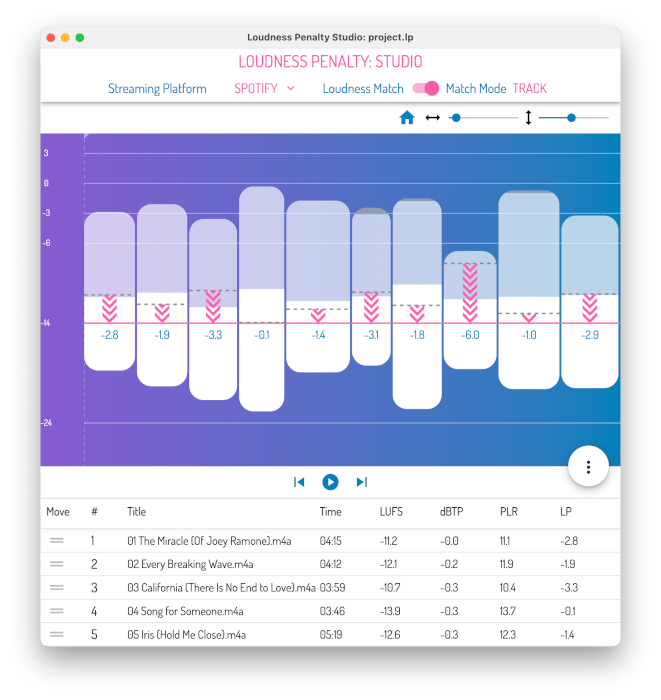
To avoid this and save us from being "blasted" unexpectedly, online streaming services measure loudness, and turn down music recorded at higher levels. We call this reduction the "Loudness Penalty" - the higher the level your music is mastered at, the bigger the penalty could be. But all the streaming services achieve this in different ways, and give different values, which makes it really hard to know how big the Loudness Penalty will be for your music...

Until now.

Simply select any WAV, MP3 or AAC file above, and within seconds we'll provide you with an accurate measurement of the Loudness Penalty for your music on many of the most popular music streaming services, and allow you to preview how it will sound for easy comparison with your favorite reference material.

Your file will not be uploaded, meaning this process is secure and anonymous.

Do you have any questions? Get in touch.
Processing audio

(but NOT uploading)

RESULTS (in dB)

0 YouTube
0 Spotify
0 TIDAL
0 Apple
0 Apple (Legacy)
0 Amazon
0 Pandora
0 Deezer

Want to take control of the Loudness Penalty for your music?

Find out how to optimize your music for impactful, punchy playback (and maximum encode quality) for all the online streaming services. Plus, receive a Loudness Penalty Report for your file that explains in detail what all the numbers mean.

Analyze another file

We just sent you an email with your report!

Analyze another file Visit MeterPlugs.com

Grammy Nomination 2000 — Yair Dalal

Though Yair Dalal did not win the Grammy in 2000, the nomination remains a crowning achievement in his career. It stands as a testament to the power of music to transcend political borders. Today, when scholars discuss the golden era of world music in the late 1990s, Silence is often cited alongside works by Nusrat Fateh Ali Khan and Ali Farka Touré as an example of uncompromising, tradition-based artistry that demands to be heard on its own terms.

The 42nd Annual Grammy Awards, held on February 23, 2000, at the Staples Center in Los Angeles, marked a historic moment for Israeli and world music. Among the nominees that year was the acclaimed Israeli violinist, oud player, and composer , whose work brought the rich tapestry of Jewish-Arab co-existence and traditional Iraqi maqamat to the forefront of the global music industry. yair dalal grammy nomination 2000

For anyone seeking to understand the roots of modern Mizrahi revival or the role of Jewish musicians in Arab maqam, Yair Dalal’s 2000 Grammy nomination is a landmark event—proof that the ancient sounds of Baghdad and Jerusalem could resonate powerfully in the heart of the entertainment industry. Though Yair Dalal did not win the Grammy

Scroll down to learn more about "Loudness Penalty"
Scroll down to learn what these numbers mean